

- Home
- »
- Contextual Enquiry & Field Research
Contextual Enquiry & Field Research
Understanding why work doesn’t happen the way it’s designed
Why procedures aren’t followed in practice
In most operations, people don’t ignore procedures because they don’t care.
They adapt because:
- Real-world constraints aren’t reflected in design
- Time pressure changes decisions
- Systems rely on experience to fill design gaps
- Controls work in theory but not in context
Until these realities are understood, organisations continue fixing symptoms rather than causes.
When contextual enquiry is the right approach
Contextual enquiry is particularly valuable when:
- Procedures are not followed consistently
- Work relies on experience, judgement, or “local knowledge”
- Different people perform the same task in different ways
- Root cause analysis keeps identifying the same causes
- Incidents or near misses recur despite corrective actions
- New technology, equipment, or processes fail to deliver benefits
In these situations, surveys, audits, and desktop reviews rarely explain why problems persist.
You need to see the work in context.
Understanding work as done — not work as imagined
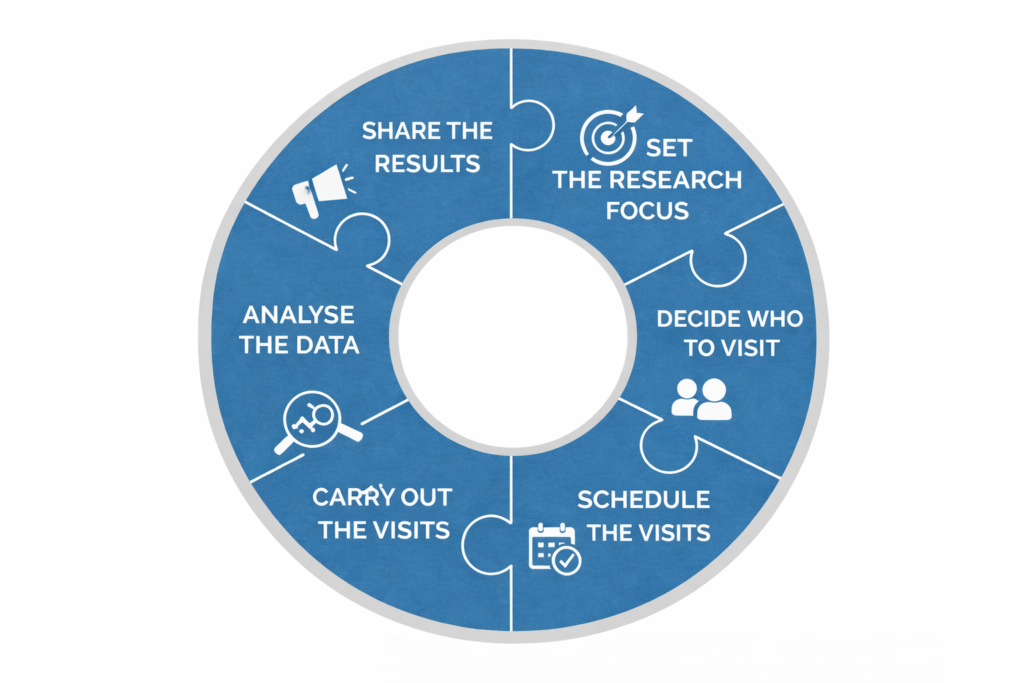
Contextual enquiry is a human factors field research approach that involves observing work as it happens and asking questions in context.
Rather than relying on retrospective descriptions of work, we focus on:
- Real task flow and sequencing
- Decisions made under pressure
- Interruptions, trade-offs, and constraints
- Informal rules, shortcuts, and adaptations
This reveals why workarounds make sense locally — even when they create risk at system level.
What we look for during field research
Our work typically examines:
- How tasks are actually prioritised and sequenced
- Where procedures diverge from reality
- Why people adapt, improvise, or bypass controls
- Tool, interface, layout, and access issues
- Communication, coordination, and handovers
- Sources of friction, delay, and hidden effort
This provides evidence of how systems really behave, not how they are assumed to behave.
What you get from contextual enquiry
Outputs are practical, proportionate, and decision-focused. They typically include:
- A clear description of work as done
- Evidence of gaps between design and reality
- Identification of hidden effort, inefficiency, or risk
- Insight into why existing controls fail in practice
- Clear input to system redesign, workload assessment, or safety-critical task analysis
Findings are translated into actions leaders can take, not academic reports.
How this supports safety, performance, and reliability
Contextual enquiry often provides the foundation for:
- Workload Risk Assessment — by revealing hidden effort, coping strategies, and pressure points
- Safety-Critical Task Analysis — by clarifying real task steps, decision points, and deviations
- Interpreting survey or assessment data accurately
It is often the best starting point when problems are complex, contested, or poorly understood.
Why Morgan Maxwell
Our approach is grounded in real operational environments, not hindsight or assumptions.
We focus on:
- Understanding work without blame
- Making system weaknesses visible
- Supporting performance under real conditions
- Producing insight that stands up to scrutiny
Take the next step
f you’re seeing signs that systems aren’t supporting people — but aren’t sure where to start — we can help.
Have questions?
We’re here to help
Morgan Maxwell is committed to transforming your workplace environments through strategic ergonomics solutions that enhance employee wellbeing, productivity, and long-term success.
Leicester Office
3rd floor, St George’s House, 6. St George’s Way, Leicester, Leicestershire, LE1 1QZ, UK
Contact Us
FAQs
Procedures are often adapted because they don’t fully reflect real-world constraints, time pressure, system design issues, or task variability. Contextual enquiry helps explain why deviations make sense locally.
Contextual enquiry is a human factors field research method that involves observing work as it happens and asking questions in context. It reveals task variability, constraints, and workarounds that are often missed by audits or interviews.
It is most useful when procedures don’t match reality, performance varies between people or shifts, issues repeat despite corrective actions, or changes fail to deliver expected benefits.
Surveys and interviews rely on people recalling or describing their work. Contextual enquiry observes work in real time, capturing decisions, trade-offs, interruptions, and adaptations as they occur.
The work is designed to be proportionate and low-burden. Scope and access are agreed in advance to minimise disruption while still generating reliable insight.
Contextual enquiry often provides the foundation by showing how work is actually done. It informs workload risk assessment by revealing hidden effort and pressure, and supports safety-critical task analysis by clarifying real task steps and deviations.
Book a free 15-minute scoping call to discuss your context and goals. We’ll help you identify the most appropriate human factors approach and the right starting point.