Most organisations track sickness absence.
Far fewer measure the biggest cost sitting underneath it: presenteeism.
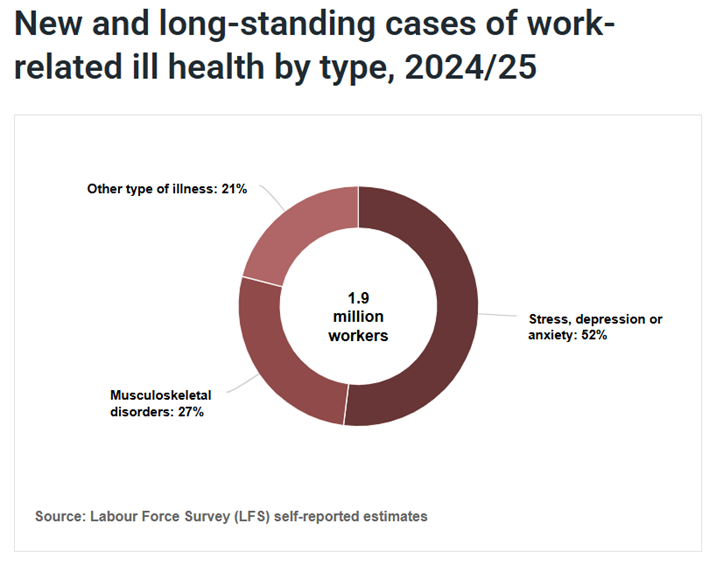
Presenteeism occurs when employees are physically present at work but operating below capacity due to pain, fatigue, or discomfort. UK and international evidence shows that presenteeism can be more costly than sickness absence, particularly when driven by work-related musculoskeletal disorders (MSDs).
This article explains:
- The difference between presenteeism and absence
- What UK research shows about MSD-related productivity loss
- Why MSDs are a major driver of presenteeism
- What organisations commonly miss — and what to do instead
Presenteeism vs Absence: Why the Biggest Cost Is Often Invisible
Sickness absence is visible.
Presenteeism is not.
Presenteeism typically shows up as slower work pace, reduced endurance, increased errors, and informal task adaptations that allow work to continue — but at a lower level of performance.
The challenge is that injury and absence data are lagging indicators. By the time MSDs appear in reports, productivity may already have been declining for months.
The UK Health and Safety Executive recognises that musculoskeletal disorders often develop gradually, with early symptoms including discomfort, fatigue, and reduced functional capacity.
UK HSE guidance on musculoskeletal disorders:
https://www.hse.gov.uk/msd/
UK Evidence: Presenteeism and Musculoskeletal Pain
UK research provides strong evidence that MSD-related presenteeism causes substantial productivity loss.
UK academic evidence
A UK study published in BMC Research Notes examined the impact of work-related musculoskeletal lower-body pain on work productivity in a large UK worker sample. The study identified significant productivity loss while people remained at work, consistent with presenteeism effects.
Full-text UK study (PubMed Central):
https://pmc.ncbi.nlm.nih.gov/articles/PMC10463619/
This supports the conclusion that a significant proportion of MSD-related work loss occurs before sickness absence, while employees are still present but operating below capacity.
UK sector evidence (construction)
Sector-specific research from Loughborough University and B&CE focused directly on presenteeism related to musculoskeletal disorders in the UK construction industry.
The report highlights that:
- Most workers continued working despite MSD pain
- The majority reported reduced performance
- Productivity loss due to presenteeism substantially outweighed absence costs
Loughborough University / B&CE report (PDF):
https://bandce.co.uk/wp-content/uploads/2021/02/Presenteeism-related-to-Musculoskeletal-Disorders-in-UK-Construction-FINAL-REPORT-SUBMITTED-TO-BCE-2020-03-31.pdf
Together, these sources show that MSD-related productivity loss often occurs before absence, making presenteeism a critical but under-measured issue.
Why Musculoskeletal Disorders Drive Presenteeism
Unlike acute injuries, musculoskeletal disorders rarely cause immediate time off work.
Instead, they tend to cause:
- Fatigue accumulation across shifts
- Reduced pace and endurance
- Loss of precision
- Informal task adaptations (“workarounds”)
Employees remain at work — but below capacity.
This pattern is supported internationally. The European Agency for Safety and Health at Work identifies MSDs as one of the leading causes of productivity loss across Europe, with presenteeism forming a significant part of the economic impact.
EU-OSHA presenteeism overview:
https://oshwiki.osha.europa.eu/en/themes/presenteeism-overview
EU-OSHA business case for addressing MSDs:
https://healthy-workplaces.osha.europa.eu/en/previous-campaigns/musculoskeletal-disorders-2020-22/business-case
What Organisations Commonly Miss
Most organisations track:
- Injury rates
- Sickness absence
- Training completion
- Compliance documentation
Few measure what appears first:
- Fatigue accumulation
- Task endurance and recovery
- Performance drift (pace, errors, rework)
- Early discomfort signals by task, department, or site
As a result, organisations can report good safety statistics while productivity quietly erodes.
Zero injuries does not mean zero loss.
Treat Ergonomics as a Leading Indicator of Performance
Reducing presenteeism requires treating ergonomics as a performance system, not just a compliance activity.
This means combining:
- Ergonomics risk assessment (posture, force, repetition, exposure)
- Workload and fatigue measurement
- Targeted task and system redesign
The UK Health and Safety Executive provides practical tools for assessing MSD risk, including manual handling and upper limb assessment tools.
HSE MSD toolkit:
https://www.hse.gov.uk/msd/toolkit.htm
How Morgan Maxwell Helps Reduce Presenteeism Costs
At Morgan Maxwell, we help organisations identify and reduce hidden productivity loss caused by musculoskeletal disorders and workload issues.
Our work focuses on:
- Evidence-led ergonomics risk assessment
- Workload and performance measurement
- Practical task and system redesign
Importantly, we also support clients using workload surveys to identify early warning signs of presenteeism, pinpointing the sites, departments, roles, or tasks where fatigue, discomfort, time pressure, or frustration are rising before performance loss escalates into absenteeism or reportable MSDs. This enables earlier intervention, protects productivity, and reduces downstream costs.
Learn more:
- Morgan Maxwell – Ergonomics & Human Factors
https://www.morganmaxwell.co.uk - Ergonomics Risk Assessment in Manufacturing
https://www.morganmaxwell.co.uk/ergonomics-risk-assessment-manufacturing/ - Manual Handling Risk Assessment – Step-by-Step Guide
https://www.morganmaxwell.co.uk/manual-handling-risk-assessment-in-manufacturing-a-step-by-step-guide-for-health-safety-managers/ - Ergonomics Training
https://www.morganmaxwell.co.uk/ergonomics-training-courses/
Key Takeaway
Presenteeism is often the largest cost of musculoskeletal disorders.
MSD-related discomfort does not need to cause absence to cause loss.
By the time injuries appear in reports, performance may already be compromised.
This is why ergonomics should be treated as a leading indicator of productivity, not just a health and safety requirement.
Frequently Asked Questions
What is presenteeism?
Presenteeism occurs when employees attend work but perform below capacity due to health issues such as pain, fatigue, or discomfort.
How do musculoskeletal disorders affect productivity?
MSDs can reduce pace, endurance, accuracy, and recovery across a shift. People may continue working, but output and quality decline before absence occurs.
What is the difference between presenteeism and absenteeism?
Absenteeism is time away from work due to illness or injury. Presenteeism is reduced performance while still present at work.
How can ergonomics reduce presenteeism?
Ergonomics reduces exposure to risk factors such as poor posture, excessive repetition, force, and inadequate recovery — helping sustain performance and prevent productivity loss.