Your risk assessments, procedures and audits all describe the work. The question is whether they describe the work that actually happens.
Ask a senior manager how a task is done and you will get one answer. Read the procedure and you will get another. Stand beside the operator on a night shift and you may see something different again.
Nobody is lying. They are describing different versions of the same work. For a health and safety manager, the distance between those versions is where much of the unmanaged risk sits.
The original idea: the task and the activity
The distinction between how work is meant to be done and how it is actually done is one of the oldest ideas in ergonomics. French ergonomists in the 1950s separated le travail prescrit (prescribed work) from le travail réalisé (work as actually carried out), most notably Ombredane and Faverge in 1955. The tradition that followed treats the gap between the two as normal, and as something to study rather than correct by instruction alone.
The idea was brought to a much wider safety audience by Erik Hollnagel through resilience engineering and his book Safety-I and Safety-II (2014), using the terms work as imagined and work as done.
- Work as imagined is how people who design, plan, manage or regulate the work believe it is carried out.
- Work as done is what really happens, in real conditions, with the time, tools, information and staffing available on the day.
Hollnagel’s central point is that the gap is not simply a failure. People constantly adjust their performance to fit conditions that the designers did not foresee. Most of the time, those adjustments are exactly why things go right. Occasionally, the same adjustments contribute to things going wrong.
For a health and safety manager, that changes the question. It is not only “why did people not follow the procedure?” but also “what did people have to adjust to get the job done, and is that adjustment safe?”
Shorrock’s extension: four varieties of human work
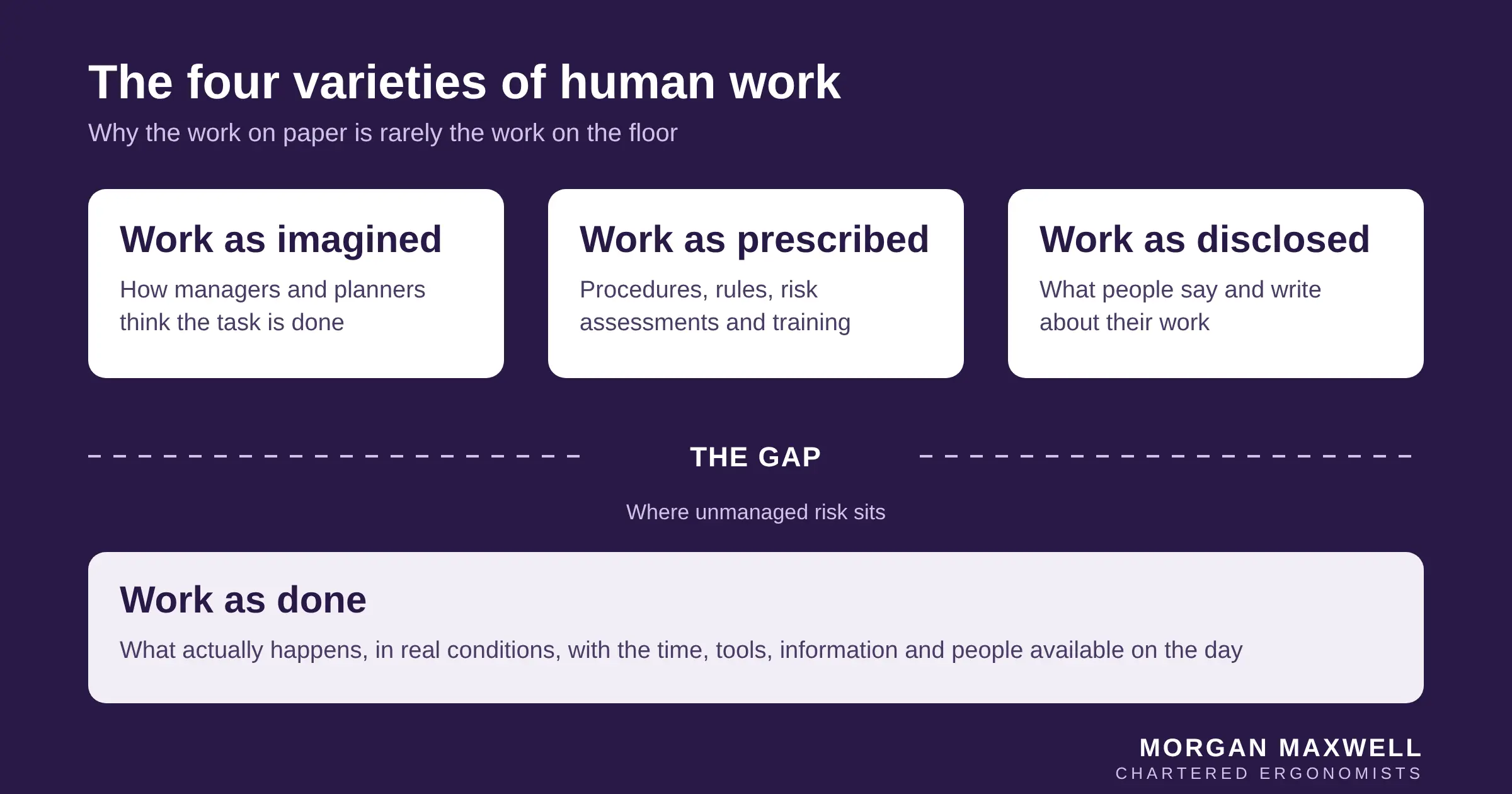
In 2016, human factors specialist Steven Shorrock extended the original idea into four varieties of human work (Shorrock, 2016). He split “imagined” into what people think and what is written down, and added what people are willing to say.
| Variety | What it is | Where you meet it | Warning signs |
| Work as imagined | How managers, engineers and planners think the work is done | Planning, resourcing, design decisions, risk assessment workshops held away from the task | Task times that never match reality; surprise at incident findings |
| Work as prescribed | The formal version: procedures, safe systems of work, permits, training | Your document management system and training records | Procedures not revised after plant or process changes; staff keeping their own notes |
| Work as disclosed | What people say or write about the work | Audits, toolbox talks, incident reports, consultation meetings | Very few near miss reports; answers that repeat the procedure word for word |
| Work as done | What actually happens on the job | Only by observing the work in its real setting | Workarounds, improvised tools, steps done out of order, jobs that overrun |
Work as disclosed is the variety most relevant to safety culture. What people tell you depends on who is asking and what they expect to happen next. If reporting leads to blame, disclosure will sound like the procedure. If it leads to improvement, you will hear about the compromises and near misses that matter.
What this means for your safety management system
HSE’s Managing for health and safety (HSG65) is built around Plan, Do, Check, Act. Each stage can quietly drift towards work as imagined.
- Plan: risk assessment. If the assessment was written at a desk, it assesses the imagined task. Walk the task with the people who do it, and check whether the controls you rely on are actually used.
- Do: procedures and training. A procedure that cannot be followed as written will not be followed. Test procedures against the real task, and review them after any change to plant, equipment, staffing or process.
- Check: audits and inspections. An announced audit mostly measures work as disclosed. Add unannounced observation and informal conversations at the workplace to see work as done.
- Act: investigations and review. “Failure to follow procedure” is where an investigation should start, not where it ends. Ask why the departure made sense to the person at the time.
HSE’s guidance on human failure, Reducing error and influencing behaviour (HSG48), makes a similar point about violations. Routine violations often take hold where rules are seen as too restrictive or no longer applying, and the remedies it suggests include making rules relevant and practical and involving the workforce in drawing them up. Closing the gap between imagined and done does exactly that.
There is also a legal angle. Under the Safety Representatives and Safety Committees Regulations 1977 and the Health and Safety (Consultation with Employees) Regulations 1996, employers must consult workers on matters affecting their health and safety (HSE, L146). Involving frontline staff in reviewing tasks and procedures is good practice, and it also helps you meet that duty.
Safety critical task analysis: a structured way to see work as done
For tasks where human failure could contribute to a major accident or serious harm, the most rigorous way to close the gap is safety critical task analysis (SCTA). It is a proactive method. Rather than waiting for an incident and investigating backwards, it examines your most critical tasks in detail and fixes weaknesses before anything goes wrong.
SCTA has three core parts:
- Task analysis, usually a hierarchical task analysis (HTA), which breaks the task into goals, sub tasks and individual steps
- Failure analysis, which asks how each step could go wrong (omitted, done in the wrong order, wrong object, wrong direction, information missed or miscommunicated), what the consequence would be, and whether it could be recovered
- Performance influencing factor (PIF) analysis, which looks at what makes each failure more or less likely: labelling, lighting, layout, time pressure, memory demands, staffing, communication and procedures
The findings then feed improvements, applied through the hierarchy of control. Where possible, the hazard or reliance on people is removed or engineered out. Where people remain essential, the PIFs are improved so the right action is easy and the wrong action is hard. The emphasis is on changing the work and the workplace, not defaulting to more training.
Why SCTA reveals work as done
An SCTA cannot be done properly at a desk. The task analysis usually starts from the existing procedure, but that is the starting point, not the answer. Procedures are often out of date, written as job aids rather than full descriptions, or grouped in a way that does not match how operators actually carry out the task.
| SCTA stage | What happens | Variety of work it brings out |
| Review the existing procedure | Draft the task structure from documents | Work as prescribed |
| Discuss with managers and engineers | Capture how the task is expected to run and what it controls | Work as imagined |
| Walkthrough at the workplace | Follow the task in its real location, with real equipment and conditions | Work as done |
| Facilitated workshop with frontline staff | Build the HTA together, agree how the task is really performed | Work as disclosed, then work as done |
| Failure and PIF analysis | Test each critical step for what could go wrong and why | The gap between imagined and done |
| Improvements and outputs | Revised procedures, job aids, competence standards, design changes | A new work as prescribed, aligned with work as done |
The workshop is where the varieties of work meet. A process safety engineer may see the task by function. An operator may see it by location, or by who does what. Good facilitation brings these views together. Where it is safe, the operators’ way of doing the task is generally given priority, because a risk assessment and procedure that do not reflect the real task have little value. Where the operators’ way is not safe, the reasons are explained. Where the preferred way is harder than the operators’ way, the job is to make the preferred way easier, which reduces the risk of violations.
None of this works without honest disclosure. People need to feel able to describe shortcuts, near misses and steps that cannot be done as written. That depends on rapport in the room and on a culture that responds to disclosure with improvement, not blame.
The regulatory context
At COMAH establishments, SCTA is a clear regulatory expectation. The COMAH Competent Authority’s Inspecting Human Factors at COMAH Establishments delivery guide (version 1.1, December 2023) expects operators to identify, prioritise and analyse COMAH critical tasks using a structured method. It names the Energy Institute’s Guidance on human factors safety critical task analysis (2nd edition, 2020) as good practice. Key elements include structured task analysis on plant and the active involvement of the frontline personnel who perform the tasks.
The same guide notes that these principles are equally relevant at non COMAH sites that rely on people to manage high consequence hazards. Road tanker offloading, breaking containment, start up after shutdown and emergency response tasks are typical examples. If your organisation relies on people to get these tasks right, SCTA is a proportionate way to show that you understand how they are really done.
Five questions to ask this month
- When were your highest risk procedures last checked against the task being done?
- Do your risk assessments include direct observation, or are they written from the procedure?
- How many near misses were reported last quarter, and does that number seem believable?
- When an incident involves a departure from procedure, does the investigation explain why it happened?
- Do the people who do the work help write the procedures they are asked to follow?
Frequently asked questions
What is the difference between work as imagined and work as done?
Work as imagined is how managers, designers and planners believe a task is carried out. Work as done is what actually happens in real conditions, with the time, tools, information and staffing available on the day. The gap between the two is normal, and it is where much unmanaged risk sits.
What are the four varieties of human work?
The four varieties, set out by Steven Shorrock in 2016, are work as imagined (what people think happens), work as prescribed (procedures, rules and training), work as disclosed (what people say about their work) and work as done (what actually happens).
Who developed the concept of work as imagined and work as done?
The distinction between prescribed and actual work comes from French ergonomics in the 1950s, notably Ombredane and Faverge (1955). Erik Hollnagel popularised the terms work as imagined and work as done through resilience engineering and Safety-II. Steven Shorrock extended the idea to four varieties in 2016.
Why does the gap between work as imagined and work as done matter for health and safety?
When the gap is wide, risk assessments describe a task nobody performs, procedures go unused, workarounds become invisible and investigations blame people for not following rules that could not be followed. Closing the gap makes risk assessments, procedures and controls reflect the real task.
How does safety critical task analysis (SCTA) help?
SCTA breaks a critical task into steps, identifies how each step could fail and examines the factors that make failure more likely. Because it uses walkthroughs at the workplace and workshops with frontline staff, it builds its analysis on work as done rather than on the procedure alone.
Is safety critical task analysis a legal requirement in the UK?
At COMAH establishments the Competent Authority expects operators to identify, prioritise and analyse COMAH critical tasks using a structured method, with frontline staff actively involved. The same principles are regarded as good practice at other sites that rely on people to manage high consequence hazards.
How Morgan Maxwell can help
Our work starts with work as done. We observe and measure tasks onsite, talk to the people who carry them out, and use structured task analysis to show where the work as imagined and the work as done have drifted apart. We then run workshops that bring managers, engineers and frontline staff together to agree procedures, controls and design changes that are safe and practical.
If you would like to understand the gap in your own organisation, get in touch with Morgan Maxwell.
References
- Ombredane, A. and Faverge, J.M. (1955) L’analyse du travail. Paris: Presses Universitaires de France.
- Hollnagel, E. (2014) Safety-I and Safety-II: The Past and Future of Safety Management. Farnham: Ashgate.
- Shorrock, S. (2016) The varieties of human work. Humanistic Systems, 5 December.
- Health and Safety Executive (2013) Managing for health and safety (HSG65). Revised edn.
- Health and Safety Executive (1999) Reducing error and influencing behaviour (HSG48). 2nd edn.
- Health and Safety Executive (2014) Consulting workers on health and safety (L146). 2nd edn.
- COMAH Competent Authority (2023) Inspecting Human Factors at COMAH Establishments: Delivery Guide. Version 1.1, December.
- Energy Institute (2020) Guidance on human factors safety critical task analysis. 2nd edn. London: Energy Institute.