There is a rule in user research that sounds rude the first time you hear it.
The first rule of finding out what people want is: don’t ask people what they want. The second rule of finding out what people want is: don’t ask people what they want.
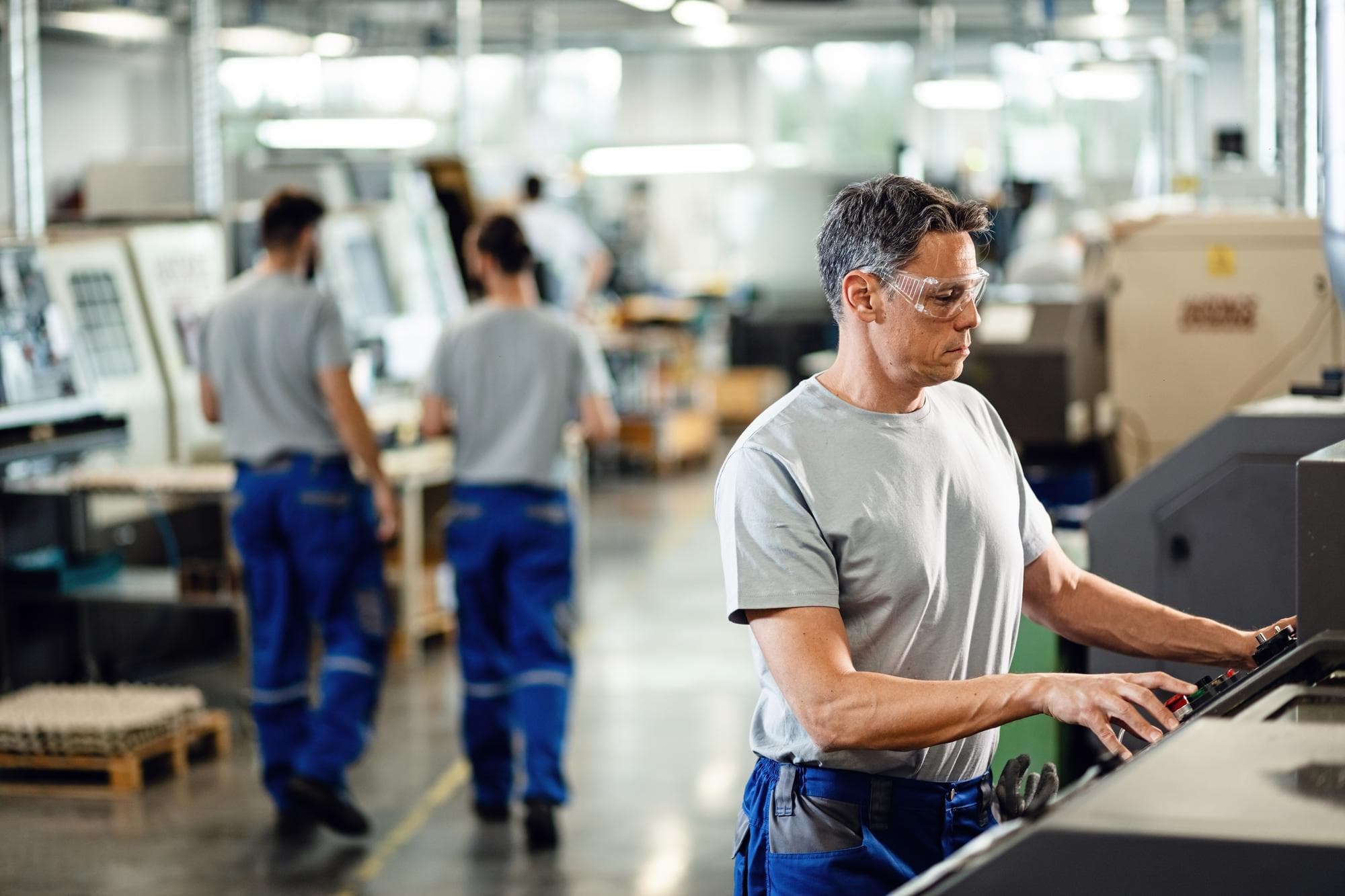
It is not that people lie. It is that nobody is a reliable narrator of their own behaviour. Ask someone how they complete a task and you will get a tidy, rationalised story. Watch them do it and you will find the workarounds, the improvised tools, the colleague who quietly helps, and the three extra steps that never appear in any procedure.
This is why surveys and focus groups are such poor instruments for discovering what people actually need — and why design ethnography and contextual enquiry sit at the heart of how we approach ergonomics, Human Factors and design work at Morgan Maxwell.
What is design ethnography?
Design ethnography is the practice of studying people in their real working environment — watching what they actually do, rather than relying on what they say they do — and turning those observations into design requirements. Field visits, day in the life studies, shadowing, contextual enquiry and customer discovery interviews are all forms of design ethnography.
Its value lies in the messy reality it captures: a person’s real interactions with equipment, technology, colleagues and their environment, their context of use, and how their needs shift over the course of a working day.
What is contextual enquiry?
Contextual enquiry (spelt contextual inquiry in the US literature) is the core method within design ethnography: a structured combination of observation and interviewing carried out where the work actually happens. The researcher takes the role of an apprentice, not an examiner. The participant is the expert in their own work; the researcher watches them do it and asks the questions an apprentice would ask.
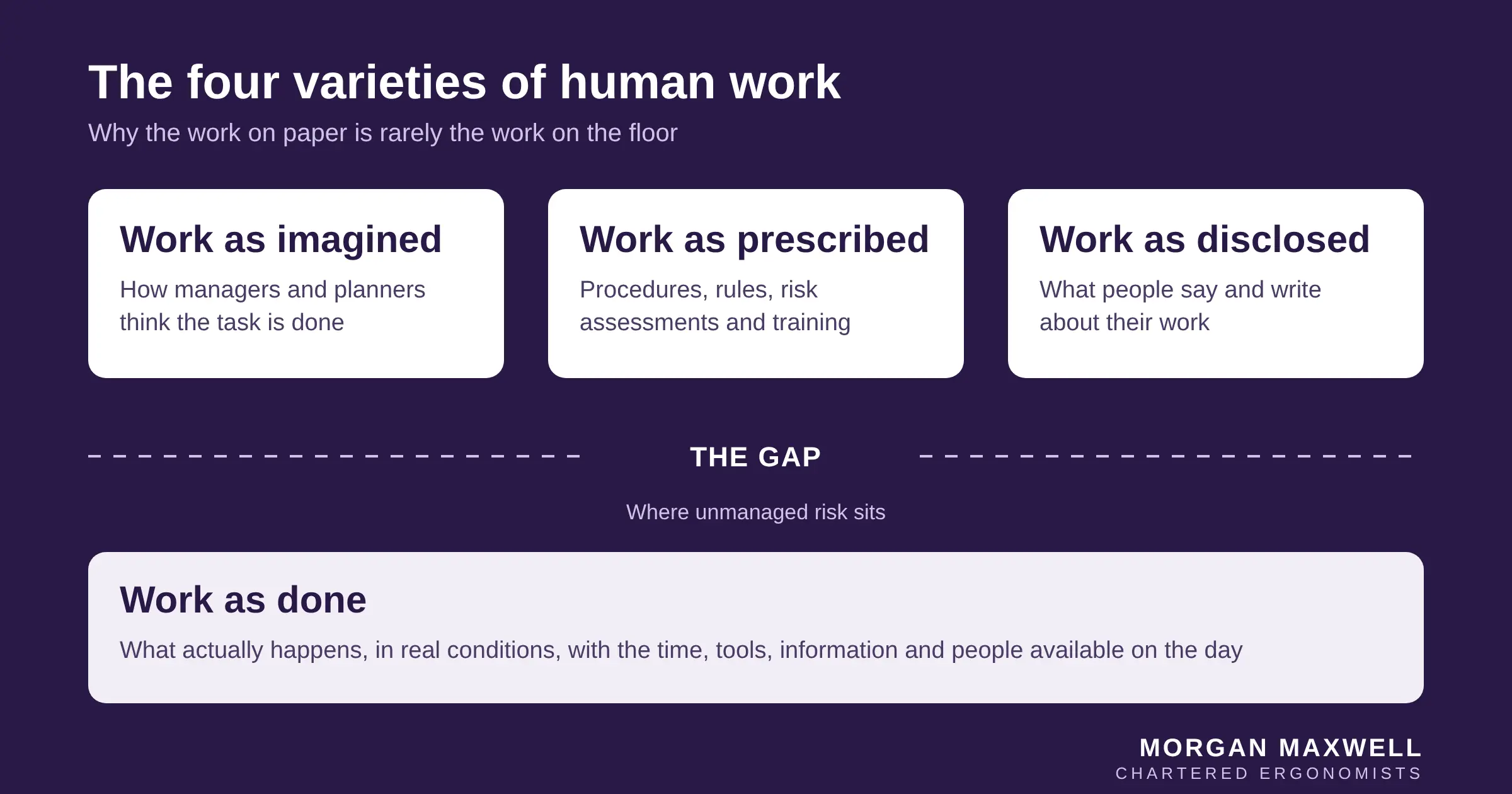
The difference from a conventional interview is the setting and the evidence. In a meeting room, people describe work as imagined. At the workbench, the treatment table or the production line, you see work as done — and the gap between the two is where most ergonomic risk, inefficiency and design failure lives.
Why not just ask users what they want?
Because needs do not exist in a vacuum. A need is a function of three things at once: the user, their goal, and their environment. Change any one and the “right” design changes with it. A tool that suits an experienced operator in a spacious workshop may fail completely for a new starter in a constrained space under time pressure.
There is a second reason. People are remarkably good at describing what they think they do and remarkably poor at noticing what they actually do. Workarounds become invisible to the people who use them every day. Tacit knowledge — the adjustments an experienced hand makes without thinking — is by definition not something a person can list in a focus group. The world is full of obvious things which nobody by any chance ever observes, and you often do not know which questions to ask until you have started watching.
A question we put to design teams: if a documentary crew spent a day following one of your users, what would the camera see and hear? If nobody can answer, the team knows its stakeholders — not its users.
How a design ethnography study works
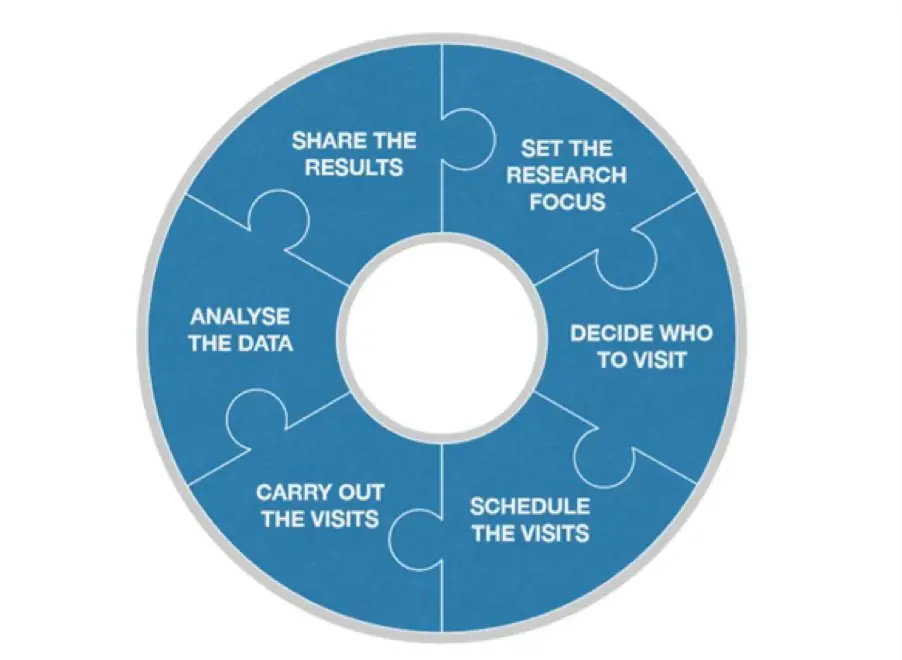
Our studies follow six stages. The structure is simple; the discipline is in doing each stage properly.
1. Set the research focus. We agree what we are studying and why, working with the people who hold critical knowledge about the work — supervisors, frontline staff, designers, health and safety teams. The output is a research question pitched at the level of the meaningful activity, not the artefact. Nobody wants a collection kiosk; people want to pick up their shopping. Nobody wants a lifting aid; people want to move stock safely and get on with their day.
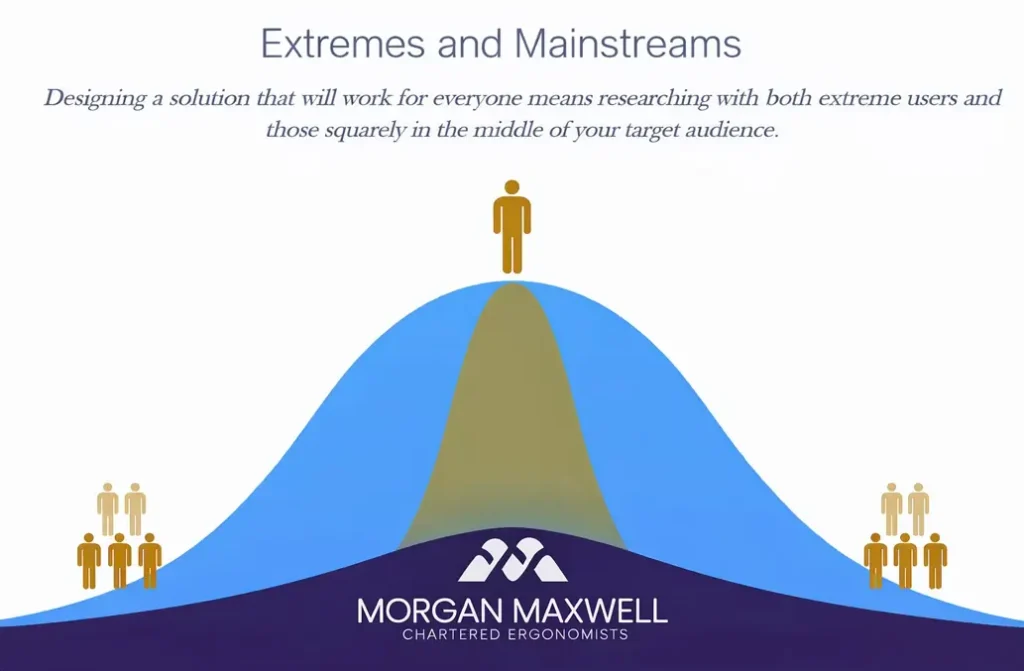
2. Decide who to visit. We do not aim for a balanced, representative sample. We use theoretical sampling: choosing individuals and groups according to how much new insight we expect from them. That means researching with both mainstream users and extreme users — because designing something that works for everyone means understanding the people squarely in the middle of the population and the people at its edges. Extreme users expose design barriers and workarounds that testing only with typical users never reveals. Ability also varies constantly: it can be reduced permanently, temporarily or situationally, and a design that accommodates that variation is better for everyone.
3. Schedule the visits. Practical planning: which sites, which shifts, which tasks. We prioritise tasks that are frequent, repetitive, physically demanding, performed in awkward spaces, time pressured, or higher consequence if something goes wrong.
4. Carry out the visits. Observation first, questions second. Sessions are structured around watching real task completion, with open questions that elicit stories rather than opinions: “Show me how you…”, “Tell me about the last time…”. Everything is done with informed consent, and photographs and notes are handled in line with agreed confidentiality and data protection requirements.
5. Analyse the data. Field observations are consolidated with any supporting measures — ergonomics risk assessment tools such as ART, MAC, RULA and REBA, body map discomfort surveys, workload measures — and the analysis compares what people say with what they do, and how the task differs across roles, sites and experience levels. The discipline here is that observations come first and interpretations second: the best evidence is something you saw or heard, not your opinion about it.
6. Share the results. Findings are translated into clear design insights, not a long academic report: what is happening, why it matters, and where intervention will help most — linked directly to design changes, engineering controls, and process or training improvements.
Design ethnography in practice: three examples
Veterinary and retail manual handling — PDSA
Working with PDSA, the UK’s leading veterinary charity, we applied design ethnography to manual handling across veterinary and retail operations. Clinics, shops and stock rooms present very different handling demands — and animal behaviour adds a level of unpredictability that no generic manual handling assessment captures.
The study combined contextual enquiry site visits with established ergonomics risk assessment tools, a body map discomfort survey and a task load survey covering physical, mental and temporal demand, effort and frustration. Theoretical sampling shaped who we observed: typical experienced staff, new starters, highly exposed staff who perform the task most often, and staff working in constrained environments.
The result was not a scored list of risky tasks. It was an evidence based picture of why the risks occur — the workflow factors, environmental constraints and informal practices behind them — translated into prioritised opportunity areas for redesign, controls and training.
Optometry and audiology environments — Specsavers
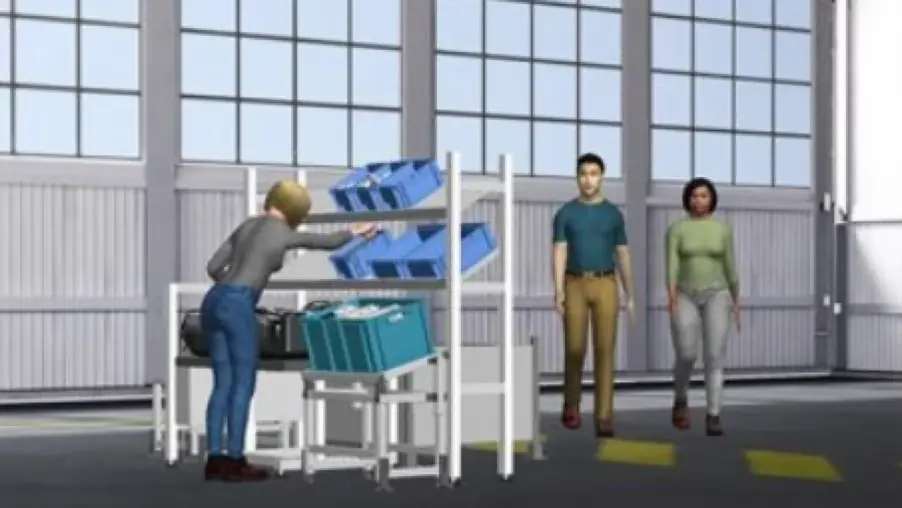
For Specsavers, we used design ethnography to inform the design of audiology and optometry testing rooms. Contextual enquiry with optometrists and audiologists in store was combined with task analysis, ergonomics assessment and the collection of anthropometric data, which was then used to build representative digital human models.
Digital Human Modelling allowed proposed room designs to be evaluated against the full range of users — from a 5th percentile female to a 95th percentile male, wheelchair users and children — before anything was built. That is the pattern we return to again and again: field research tells you what to design for; simulation and modelling let you test the design before it is committed; and a right first time approach avoids costly redesign later.
Testing a prototype automation product with real users — Ocado
For Ocado, we supported the development of a new customer facing automation product, combining Digital Human Modelling with a targeted design ethnography and physical usability study of the prototype.
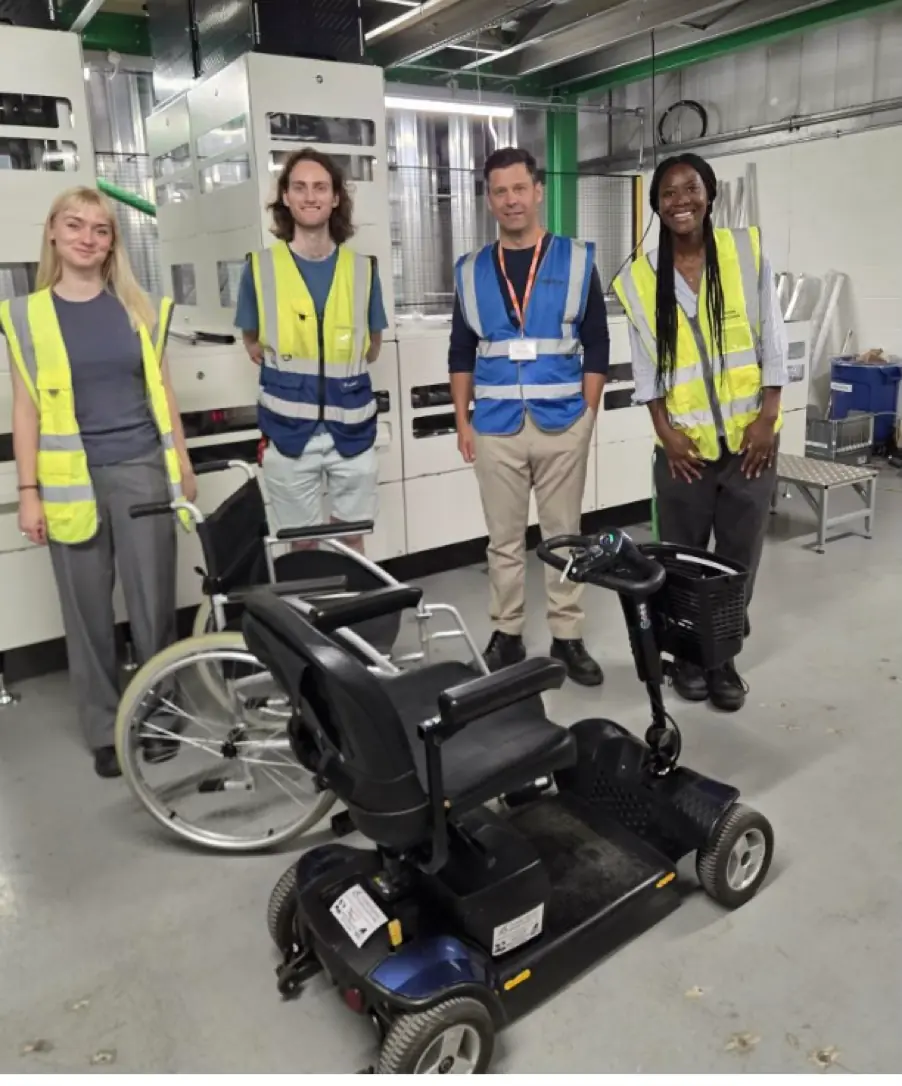
DHM had already assessed reach, line of sight, posture and physical fit against agreed anthropometric user groups. The ethnographic phase then tested how real users actually behaved with the prototype — including wheelchair users, older users with reduced mobility, and users with lower confidence using technology — observing first time use, hesitation points, physical access issues and workarounds, and comparing real behaviour against the DHM assumptions.
This is the crucial point about simulation and field research: they answer different questions. Modelling predicts whether a design physically fits its users. Watching real people tells you whether they understand it, trust it, and use it the way the design team expects — and it surfaces requirements that no model can generate.
What design ethnography gives you that automated tools cannot
AI driven ergonomics tools are getting very good at what they do: posture detection, joint angle analysis, initial risk scoring, screening at scale. We use this technology ourselves. But automated analysis measures the body; it does not understand the work.
Software cannot tell you why an operator adopts an awkward posture, what production pressure lies behind a workaround, which informal practice is actually keeping the process running, or whether a proposed intervention will survive contact with a real shift. Those answers come from watching real work, in context, with a trained eye — and then converting what you see into user requirements, design requirements, and designs that are tested and validated with the people who will use them.
That is the difference between identifying problems and designing them out. We do not simply assess people interacting with poorly designed work, products and equipment. We work to understand why problems occur — and help design better work, products and systems.
Frequently asked questions
Design ethnography is the broad practice of studying people in their real environment to inform design; contextual enquiry is its core method — structured observation and interviewing carried out where the work happens, with the researcher in the role of apprentice and the participant as the expert.
Far fewer than a survey. Because participants are chosen by theoretical sampling — for the insight they are expected to generate, not statistical representation — a targeted study typically involves around 12 to 20 participants across mainstream and extreme user groups.
A targeted study is typically completed within three to five weeks of approval, depending on site access and scheduling. Larger multi site programmes are scoped in stages.
A clear findings report or design review deck: observed behaviours, pain points and workarounds, comparison against any modelling or assessment data, and prioritised design recommendations — categorised so your team knows what must be addressed, what should be addressed, and what could be improved.
Use field research when you need the big picture: real world workflow across channels, systems you cannot otherwise access, collaboration between people, or environments that shape behaviour. Lab based usability testing answers a narrower question — whether people can complete tasks you have already defined.
Morgan Maxwell is a CIEHF Registered Consultancy. Our design ethnography and contextual enquiry work is led by a Chartered Ergonomist and feeds directly into design: user requirements, design requirements, Digital Human Modelling, prototype testing and validation. If you are developing a product, workplace or process and want to understand how people will really use it, book a 15 minute scoping call.