The operator didn’t follow the procedure. That’s not a root cause. It’s a symptom.
When something goes wrong at work, the investigation often stops at the person. Yet the reasons people make errors, or move away from a procedure, are usually found in the conditions around them. Human factors specialists call these conditions performance influencing factors, or PIFs.
This guide explains what performance influencing factors are, how the Health and Safety Executive (HSE) groups them, and how to find them on your own site before they lead to an incident.
What are performance influencing factors?
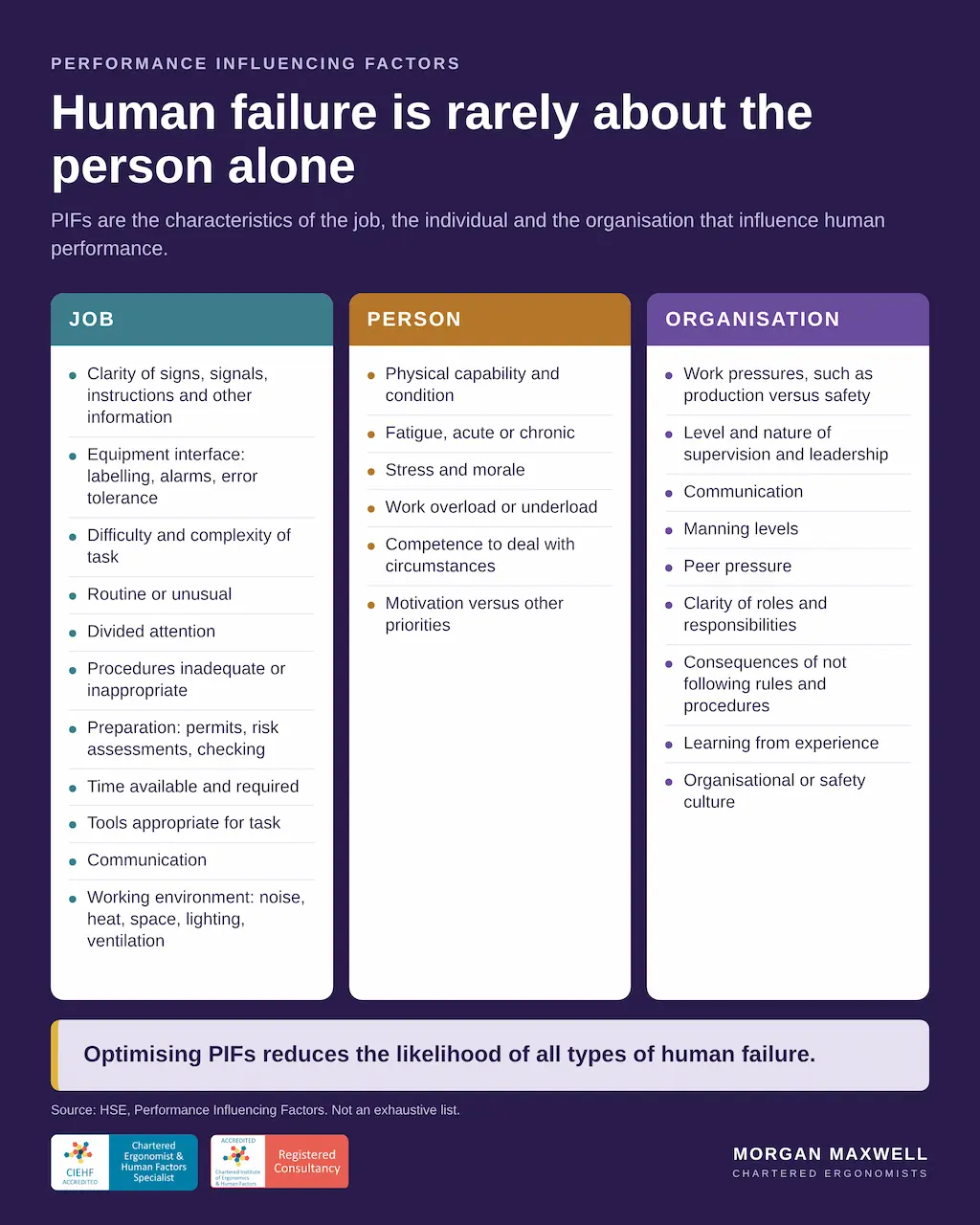
Performance influencing factors are the characteristics of the job, the individual and the organisation that influence human performance. That is the definition used in the HSE performance influencing factors guidance. You may also see them called performance shaping factors; the meaning is the same.
PIFs can work in both directions. Negative PIFs make failure more likely, such as poor labelling or time pressure. Positive PIFs make failure less likely, such as clear instructions or an experienced team. Both are worth recording.
The HSE is clear that human failure is not random. Its guidance on managing human failures explains that the likelihood of human failure depends on the condition of a limited number of performance influencing factors. Improve those conditions and you reduce the likelihood of failure.
The three groups of HSE performance influencing factors
The HSE groups PIFs into job, person and organisation factors. Its list is not exhaustive, but it is a practical starting point for any risk assessment or investigation.
Job factors
- Clarity of signs, signals, instructions and other information
- System and equipment interface, including labelling, alarms and error tolerance
- Difficulty and complexity of the task
- Whether the task is routine or unusual
- Divided attention
- Procedures that are inadequate or inappropriate
- Preparation for the task, such as permits, risk assessments and checking
- Time available and time required
- Tools appropriate for the task
- Communication with colleagues, supervisors and contractors
- Working environment, including noise, heat, space, lighting and ventilation
Person factors
- Physical capability and condition
- Fatigue, whether acute or chronic
- Stress and morale
- Work overload or underload (see our guide on how to measure workload at work)
- Competence to deal with the circumstances
- Motivation versus other priorities
Organisation factors
- Work pressures, such as production versus safety
- Level and nature of supervision and leadership
- Communication
- Manning and staffing levels
- Peer pressure
- Clarity of roles and responsibilities
- Consequences of not following rules and procedures
- How well the organisation learns from experience
- Organisational or safety culture
Why PIFs matter more than blaming the operator
“Human error” explains what happened, not why it happened. The HSE’s guidance on investigating accidents and incidents says investigations should consider why human failures occurred, because finding the underlying causes is the key to preventing similar accidents.
Consider a familiar pattern. An operator isolates the wrong pump. The investigation finds operator error and the action is retraining. Six months later a different operator makes the same mistake on the same plant. The labels were never updated after a modification, the lighting is poor and the job is always rushed at the end of a shift. Those are the PIFs, and they were waiting for the next person.
This is why retraining so often fails. Slips and lapses are made by experienced, well trained people, so more training rarely changes the outcome. The HSE’s guidance on managing human failures, and its core publication Reducing error and influencing behaviour (HSG48), both point to better task and equipment design as the more reliable control.
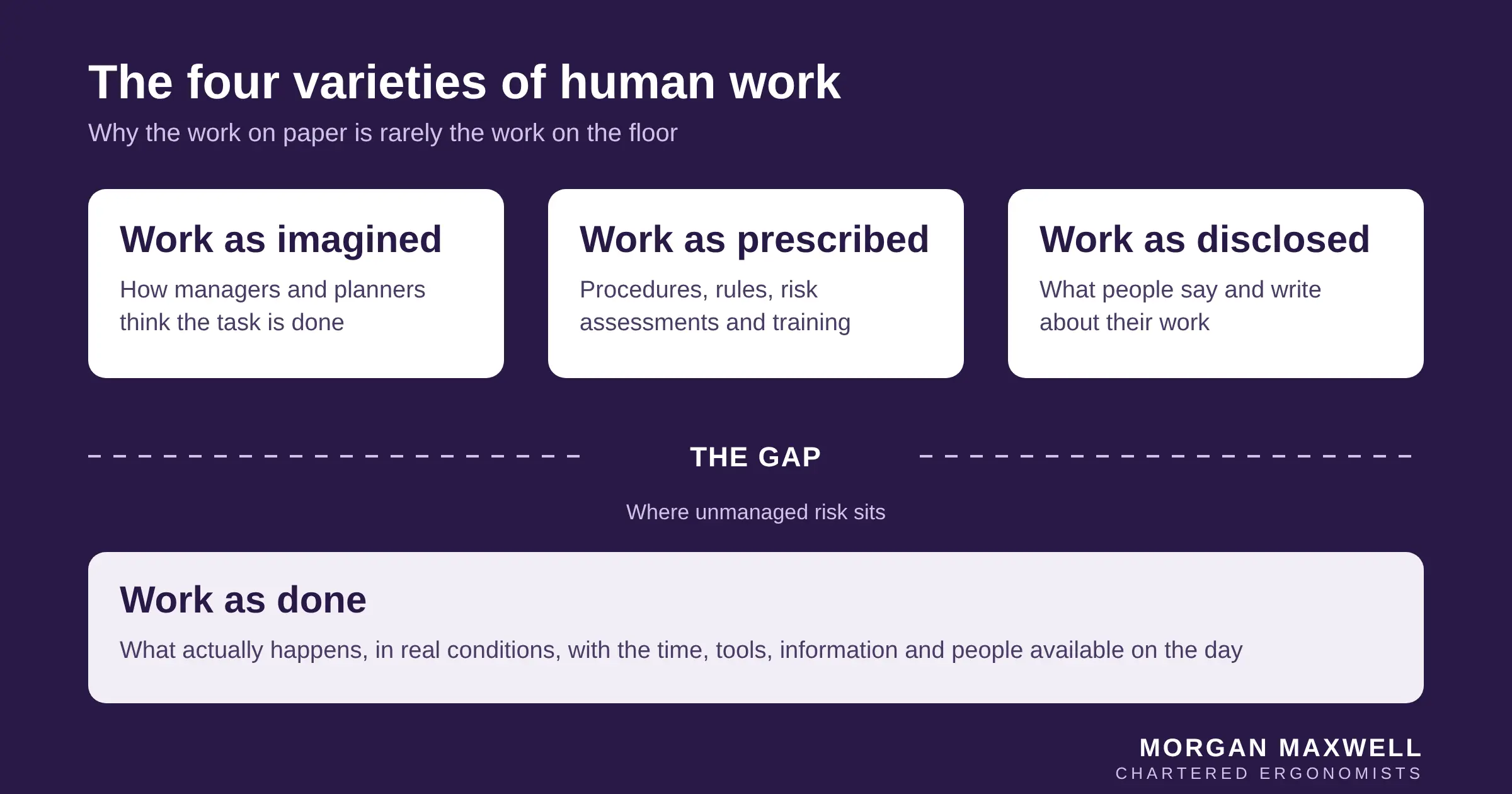
PIFs and the gap between work as imagined and work as done
PIFs explain much of the gap between how a task is written down and how it is really carried out. We explored that gap in our article on work as imagined vs work as done.
People rarely move away from a procedure for no reason. A faded label means they go by position. An awkward valve means a check gets skipped. A short shift means two jobs are done at once. Each adaptation is a response to a PIF.
Sometimes those adaptations are what keep the job safe. Sometimes they contribute to things going wrong. You can only tell which by seeing the work as it is done, which is why we use contextual enquiry and field research rather than relying on documents alone.
How performance influencing factors are assessed in safety critical task analysis
Safety critical task analysis (SCTA) is one of the most structured ways to identify PIFs before an incident. It looks forward, analysing a task before anything goes wrong rather than after. It follows four steps:
- Break the task down. A hierarchical task analysis maps each step as the task is actually done, built with the people who do it.
- Identify credible failures. Each step is classed as an action, a check, information retrieval or a communication, and tested against the ways that type of activity can fail.
- Assess the PIFs. For each credible failure, the analysis records the negative and positive PIFs that make it more or less likely on that site, along with the consequence and any chance of recovery.
- Apply the hierarchy of control. First ask whether engineering or automation can remove the reliance on people. Where people still carry out the step, improve the PIFs.
The output is a set of practical, prioritised recommendations. These often include clearer procedures, better labelling and changes to staffing or task timing, rather than retraining alone.
Five questions to ask about PIFs on your site
- For your highest risk task, when did someone last watch it being done rather than read the procedure?
- Do your incident investigations record the conditions at the time, or stop at “failed to follow procedure”?
- Are labels, signs and displays still accurate after recent changes to plant or equipment?
- Is the time allowed for critical tasks realistic, including at the end of a shift or during handover?
- Which PIF does everyone on site already know about, but nobody has fixed?
If any of these are hard to answer, that is a sign your risk assessments may be describing work as imagined rather than work as done.
Frequently asked questions about performance influencing factors
What is a performance influencing factor?
A performance influencing factor is any characteristic of the job, the person or the organisation that makes human failure more or less likely. Examples include unclear labelling, fatigue, time pressure and staffing levels.
Are performance influencing factors the same as performance shaping factors?
Yes. The two terms are used interchangeably. Performance influencing factors is the term used by the HSE in the UK.
Who publishes the list of PIFs?
The HSE publishes a list of performance influencing factors grouped into job, person and organisation factors. It is a starting point, not an exhaustive list.
How do PIFs relate to slips, lapses, mistakes and violations?
PIFs influence every type of human failure. Distractions and poor interface design make slips and lapses more likely. Poor information and unfamiliar situations make mistakes more likely. Unworkable procedures and production pressure make violations more likely.
Will retraining fix a human error problem?
Only if the cause is a lack of knowledge or skill. Most errors are made by trained, experienced people, so the lasting fix is usually to change the conditions they work in.
How Morgan Maxwell can help
Morgan Maxwell is a CIEHF Registered Consultancy led by Chartered Ergonomists. Our human factors team identifies the performance influencing factors behind error, fatigue and performance variation, and helps you control them.
We can help with:
- Safety critical task analysis for your highest risk tasks
- Fatigue risk assessment and mental workload reviews
- Contextual enquiry and field research to see work as it is done
- Expert witness evidence on ergonomics and human factors
To talk through a task you are concerned about, book a free 15 minute scoping call.